
If you’ve spent any time shopping for trucking management software, you’ve probably noticed something: pricing is either buried six pages deep on the website, or it’s dressed up in “contact sales” buttons that lead to a 45-minute pitch. And when you finally get a number, it’s loaded with per-user fees, implementation costs, and mystery line items that make your accountant wince.
Here’s the reality: most software companies build pricing models that work for them, not for you. They want recurring revenue that scales with your team size, not your truck count. So they charge per dispatcher, per admin, per “seat”—even though your actual operation runs on trucks, not logins.
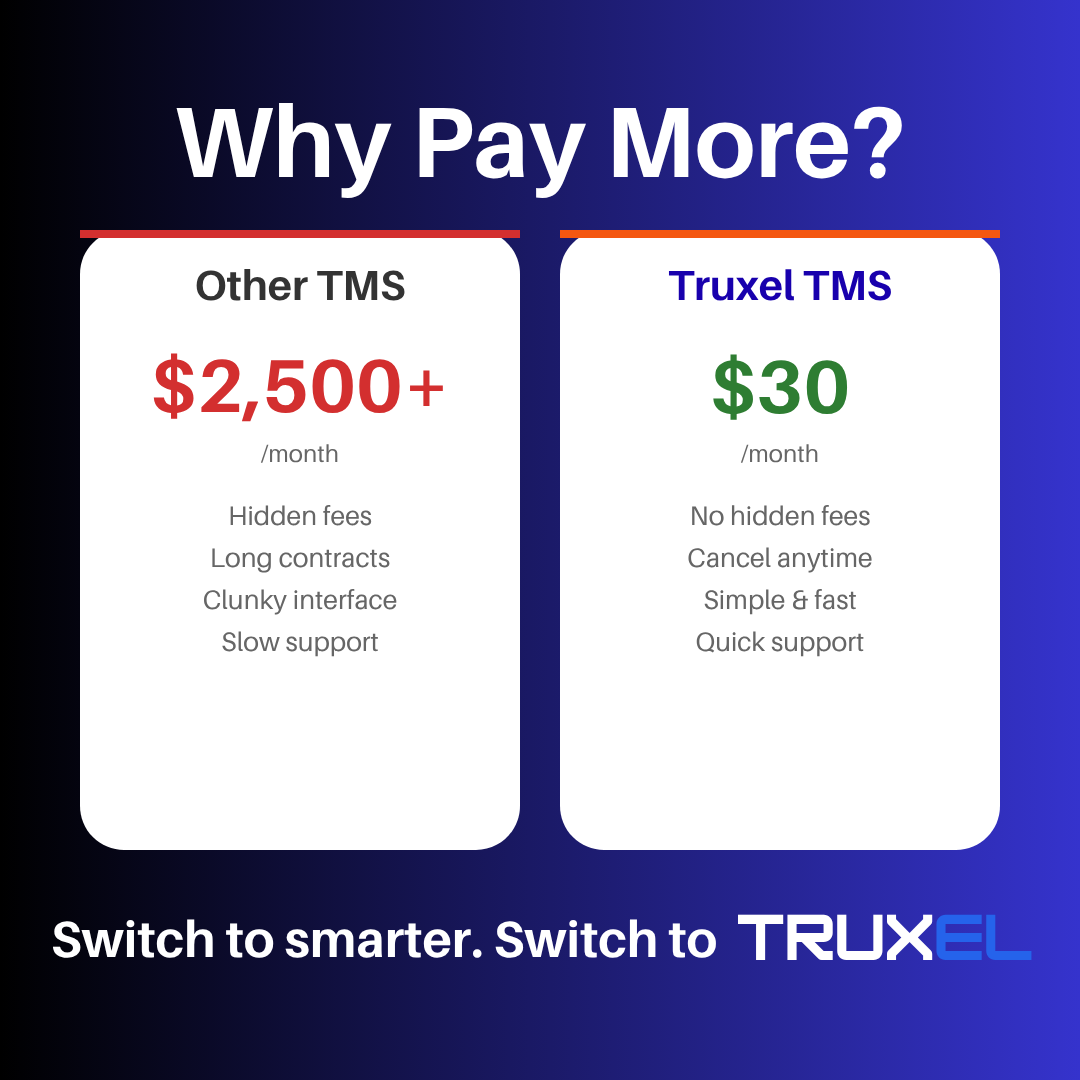
Truxel TMS was built differently. No per-user nonsense. No hidden setup fees. Just $30 per active truck, per month. This guide breaks down why traditional TMS pricing models don’t make sense for most carriers, what you’re actually paying with platforms like TruckBase and Alvys, and how Truxel TMS gives you a clearer, cheaper path forward.
Why Most Trucking Software Companies Overcharge Carriers
The Per-User Pricing Trap
Per-user pricing is the SaaS industry’s favorite trick, and it’s everywhere in trucking software. You’ll see it marketed as “flexible” or “scalable,” but here’s what it really means: every time you add a dispatcher, a safety manager, or a back-office admin, your monthly bill goes up—even if your fleet size stays the same.
Let’s say you run 15 trucks and you have three people accessing the system: a dispatcher, an operations manager, and someone handling billing. A typical TMS with per-user pricing might charge $99/user/month. That’s $297/month before you’ve even moved a load. Now add seasonal help during peak months, or cross-train a driver to help with dispatch on weekends, and suddenly you’re paying for five or six users. Your software bill just hit $600/month for the same 15 trucks.
The math doesn’t track. Your revenue is tied to how many trucks you run and how many loads you move—not how many people log into a dashboard. Per-user pricing penalizes efficiency. It discourages you from giving your team the tools they need because every login costs money.
Hidden Costs That Add Up Fast
Even if you’re okay with per-user fees, most TMS platforms don’t stop there. You’ll run into:
- Implementation or onboarding fees: Some software companies charge $500–$2,000 to “set up” your account, which often means a 30-minute call and a pre-built template.
- Training costs: Want a recorded walkthrough or live training session? That’ll be extra.
- API or integration fees: Need to connect your ELD, accounting software, or load board? Some platforms charge per integration or limit API access to higher-tier plans.
- Support tiers: Basic support might be email-only with 48-hour response times. Want phone support or same-day help? Upgrade to the premium plan.
These costs aren’t always listed on the pricing page. You find out during the sales call, after the contract is signed, or when you get your first invoice. It’s frustrating, and it erodes trust.
TruckBase Pricing and Alvys: What You’re Really Paying
Let’s look at two of the more popular TMS platforms and how their pricing actually shakes out.
TruckBase TMS Pricing Breakdown
TruckBase is a solid software company with a modern interface and strong dispatch tools. But TruckBase pricing is notoriously hard to pin down without talking to sales. Based on user reports and publicly available info, here’s the general structure:
- Per-user model: TruckBase charges per user, typically starting around $75–$125/user/month depending on the plan and feature set.
- Minimum user requirements: Some plans require a minimum number of users (often 3–5), so even a small carrier might be paying for seats they don’t need.
- Add-ons: Advanced features like IFTA reporting, document management, or certain integrations may come at an additional cost.
For a 10-truck operation with three users, TruckBase TMS pricing could easily land in the $250–$375/month range. For 25 trucks with five users, you’re looking at $500–$625/month or more. That’s before any implementation fees, training costs, or premium support.
TruckBase is a good product—but for small to mid-size carriers, the pricing model can feel heavy, especially when your truck count is stable but your software bill keeps climbing as you add team members.
Alvys Pricing Model
Alvys takes a similar approach. It’s a feature-rich platform built for larger fleets, and the pricing reflects that. Alvys typically charges per user, with costs reported in the $100–$150/user/month range for mid-tier plans. Like TruckBase, you’ll often need to talk to sales to get exact numbers, and there may be setup fees or minimums involved.
For carriers running 10–30 trucks, Alvys can work well—but the cost structure assumes you’re managing a more complex operation with multiple dispatchers, load planners, and back-office staff. If you’re a leaner operation trying to keep overhead low, you’re paying for capacity you might not use.
We’ve covered the Truxel TMS vs. Alvys comparison in detail here, but the short version is this: Alvys is built for scale, and the pricing reflects enterprise-level complexity. If you’re not there yet, you’re overpaying.
How Truxel TMS Pricing Actually Works
$30 Per Truck, Per Month—That’s It
Truxel TMS uses a per-truck pricing model because that’s what makes sense for carriers. You pay $30/month for every active truck in your fleet. If you run 10 trucks, you pay $300/month. If you run 25 trucks, you pay $750/month. Simple, predictable, tied to the revenue-generating part of your business.
No per-user fees. Your dispatcher, safety manager, accountant, and weekend backup can all log in without adding to the bill. You’re not penalized for cross-training your team or giving more people access to the system.
What’s Included (No Nickel-and-Diming)
Here’s what you get with Truxel TMS at $30/truck:
- Dispatch and load management: Assign loads, track drivers, monitor delivery status.
- Driver pay and settlement: Calculate driver pay, manage deductions, export payroll-ready reports.
- IFTA and mileage tracking: Automated IFTA reporting, state-by-state breakdowns.
- Document management: Upload and organize rate confirmations, PODs, invoices, permits.
- Invoicing and billing: Generate invoices, track payments, manage aging reports.
- Integrations: Connect your ELD, accounting software, and load boards without extra fees.
- Support: Email and chat support included. No tiered support plans, no upsells.
No setup fees. No onboarding charges. No “contact us for enterprise pricing.” Just straight-up software that works.
Real-World Cost Comparison: 10-Truck Fleet
Let’s run the numbers for a 10-truck carrier with three people accessing the system (a dispatcher, an operations manager, and a back-office admin).
| Platform | Pricing Model | Monthly Cost Estimate |
|---|---|---|
| TruckBase | ~$100/user × 3 users | $300/month |
| Alvys | ~$125/user × 3 users | $375/month |
| Truxel TMS | $30/truck × 10 trucks | $300/month |
At first glance, TruckBase and Truxel TMS look similar for this scenario. But here’s the difference:
- Add a fourth user (seasonal dispatcher, safety manager, or admin help), and TruckBase jumps to $400/month. Truxel stays at $300.
- Grow to 15 trucks without adding staff, and Truxel goes to $450/month. TruckBase stays at $300 (or $400 if you added that fourth user). Your costs scale with your actual growth, not your org chart.
Over a year, those differences add up. And if you’re comparing multiple software companies, the transparency alone is worth something. You know what you’re paying, and you know why.
When Expensive Software Makes Sense (and When It Doesn’t)
Look, expensive TMS platforms aren’t always a rip-off. If you’re running 100+ trucks, managing multiple terminals, handling complex brokerage operations, or need deep integrations with legacy systems, a higher-cost platform might deliver ROI. Enterprise-level features cost money to build and support.
But if you’re a small to mid-size carrier focused on running loads, getting drivers paid, staying IFTA-compliant, and keeping your back office organized, you don’t need enterprise software. You need tools that work without the bloat.
That’s where Truxel TMS fits. It’s built for carriers who want to move past spreadsheets and entry-level tools without overpaying for features they’ll never use. If you’re still managing dispatch in Excel or Google Sheets, here’s why a TMS beats spreadsheets and how Truxel helps you scale cleanly.
Making the Switch: What to Expect
Switching TMS platforms can feel like a headache, but it doesn’t have to be. Here’s what the process looks like with Truxel:
- Sign up and set up your fleet: Add your trucks, drivers, and basic company info. Takes about 20 minutes.
- Import your data: Upload existing load history, driver info, and documents if you want a clean starting point. (Optional—you can start fresh if you prefer.)
- Connect integrations: Link your ELD, accounting software, and load boards. Most integrations are plug-and-play.
- Train your team: Truxel’s interface is designed to be intuitive. Most users are up and running within a day or two.
No implementation fees. No mandatory onboarding calls. No six-week rollout plan. You can be live in under a week.
Get Started with Truxel TMS
If you’re tired of per-user fees, hidden costs, and pricing that doesn’t match how your business actually works, Truxel TMS is built for you. $30 per truck, per month. No surprises. No upsells. Just dispatch, operations, and back-office tools that help you run a tighter operation.
Check pricing and start your free trial—see what $30/truck actually gets you.
And if you’re still shopping for the right ELD to pair with your TMS, get matched with vetted ELD providers here—we’ll connect you with options that fit your fleet size and budget.
Disclosure: This post may contain affiliate links. If you use them, we may earn a commission at no extra cost to you.
WHO THIS IS FOR
- Small to mid-size carriers (5–50 trucks) looking to switch from overpriced TMS platforms
- Fleet owners tired of per-user pricing models that don’t scale with actual growth
- Dispatchers and operations managers evaluating TruckBase, Alvys, and other TMS options
- Carriers currently using spreadsheets and ready to upgrade without breaking the bank
KEY TAKEAWAYS
✅ Per-user pricing penalizes efficiency—you shouldn’t pay more just because you cross-train your team or add seasonal help.
✅ TruckBase pricing and Alvys pricing are built for larger fleets and can feel heavy for small to mid-size carriers.
✅ Truxel TMS charges $30/truck/month—simple, predictable, and tied to the part of your business that actually makes money.
✅ Hidden costs add up fast—setup fees, training charges, integration fees, and tiered support plans can double your effective monthly cost.
✅ Switching is easier than you think—no implementation fees, no mandatory onboarding, and most carriers are live in under a week.
Leave a Reply